Showing posts with label Beans and Lentils. Show all posts

Friday, December 7, 2007

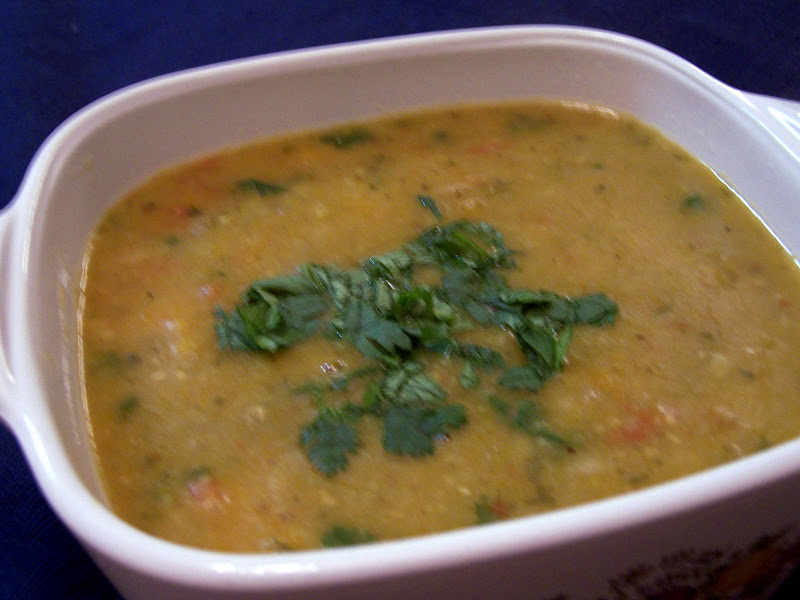
Parsi Dhansaak

JFI which stands for Jihva For Ingredients celebrates an ingredient every month, it is the brainchild of very talented and thoughtful Indira of Mahanandi. This time around it is being hosted by sweet and generous Linda of Out of The Garden. Every time I look at her passionately cooked Indian food I have to remind myself that this energetic lady is not an Indian! Linda chose Toor daal as the theme for JFI - December.

Toor daal is the backbone of Indian food. It is an omnipresent feature of Indian main course. This is how toor daal is normally made in Indian homes:
1. The basic cooking of this lentil requires cooking it with water and salt (and turmeric many times) till 'done'. The definition of 'done' varies. Some people like their daal to be so mushy that you can't distinguish the grain where as some people prefer it to be firmer. For the large part I think the former is more common.
2. The consistency of the daal varies again! Some people cook it to be very thick whereas in some homes its more diluted and thin.
3. The seasoning - I think daal in every home tastes different thanks to the variation in texture, consistency and mostly the tempering. Tempering/tadka/vaghar is normally prepared with hot ghee/oil, mustard/cumin seeds and asafoetida (basic ingredients), then there is no end to what you can do - use fenugreek (methi seeds), cloves, cinnamon, dry red chillies. Different combinations of fresh ingredients like - tomatoes, tamarind, lemon, green chillies, cilantro, curry leaves, ginger, garlic are quite common. Many versions of toor daal have a hint of sweetness by means of sugar or jaggery. Gujarati daal also contains cooked peanuts, which adds a wonderful flavor and fullness to the normally thin daal.

Toor daal is cooked in combination with a variety of vegetables which adds up to some great nutritive properties and makes some fantastic dishes!
1. Sambhar (that Linda *loves*) is Southern India's delightful gift to the rest of the country! It is made with a special spice mix made with common Indian spices like cumin, coriander, fenugreek etc, fresh vegetables and coconut (sometimes).
2. Daal-palak (Spinach and toor daal) is another lovely combination cooked in a thousand different ways. Silken toor daal works very well with all green leafy vegetables like fenugreek, amaranth to name a couple.
3. Dhansaak (Dhan = Daal + Saak = Vegetables)is a Parsi delicacy made with a variety of daals, vegetables and meat. It can easily be adapted into a vegetarian version. Read more about Parsi cuisine here.

I make toor daal in various ways and just love Sambhar. But I wanted to cook something different for this event and Parsi dhansaak seemed like a good choice!

I used a recipe our sweet friend N sent me and tweaked it to suit our taste and the ingredients I had on hand. If I still remember correctly her recipe was inspired by Tarla Dalal's.

Serves 4 easily
Ingredients
1/2 cup toor (arhar) dal (split pigeon peas)
1 tbsp yellow moong dal (split yellow gram)
1 tbsp masoor dal (split red lentils)
1 tbsp urad dal (split black lentils)
1-2 cups butternut squash chopped
1 tbsp fenugreek (methi) leaves, chopped
1 tomato, chopped
1 small onion, chopped
1 tsp tamarind paste (mine is quite concentrated, if making your own increase quantity to 2 tsp)
2 tsp oil
salt to taste

To be ground into a paste
1 green chilli
3 whole red chillies
2 large cloves garlic
1 stick cinnamon
4 cloves
A small piece of ginger
1 green cardamom
1 tsp coriander seeds
4 peppercorns
1/2 tsp cumin seeds
Handful of chopped coriander

Method
1. Clean and wash the dals.
2. Combine the dals and butternut squash with 3 cups of water and pressure cook for 3-4 whistles. Keep aside.
3. Heat the oil in a pan, add chopped onions and sauté till translucent. Add chopped methi and tomatoes and sauté for 2 mins.
4. Add the prepared paste and sauté for 2 minutes.
5. Add the dal and vegetables, tamarind paste and salt and simmer for 10 to 15 minutes.
6. Sprinkle a pinch of cardamom powder (the original recipe called for cinnamon, clove and cardamom powder).
7. Garnish with chopped coriander and serve with hot rice.

Dhansaak is traditionally served with brown rice. I did not have time to make it but I can imagine the combination would be wonderful. A delightful kachumbar (salad) made with finely chopped onions, tomatoes, carrots, coriander and seasoned with lime juice, red chilli powder, salt and roasted cumin powder is served as an accompaniment to dhansaak and brown rice.


I think dhansaak is supposed to be made with more vegetables - the original recipe called for potatoes, eggplants, pumpkin and bottle gourd. I just increased the amount of butternut squash. Zucchini, carrots would work well too. Spinach should be a great addition!

Also, according to the recipe - the cooked daal + vegetables were supposed to be pureed, I just couldn't get myself to do that! I'd rather overcook my daal and veggies to a mush :D

Dhansaak was bursting with flavors. Tasted better the next day! I loved it with roti too. We found the taste of garlic a little overbearing, but that is just because we don't like it much. All in all a very healthy, balanced dish with some amazing combination of flavors!

Thursday, November 15, 2007

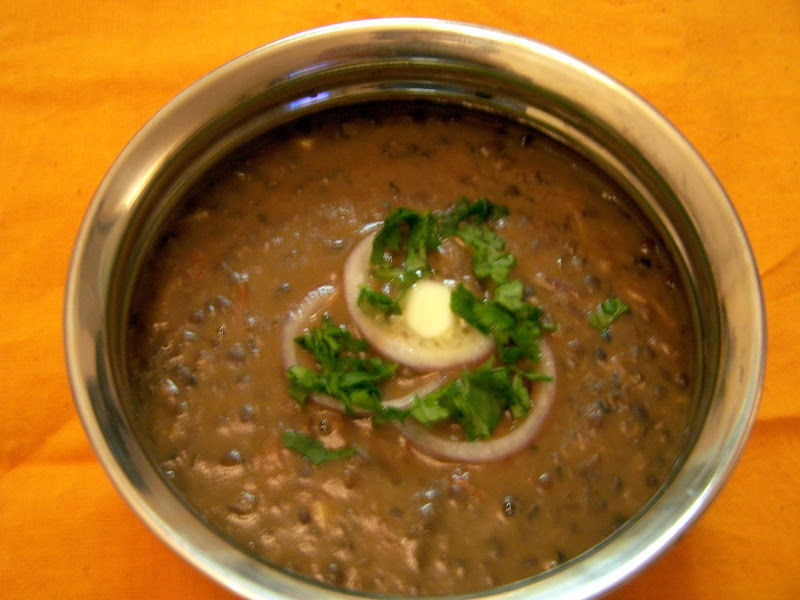
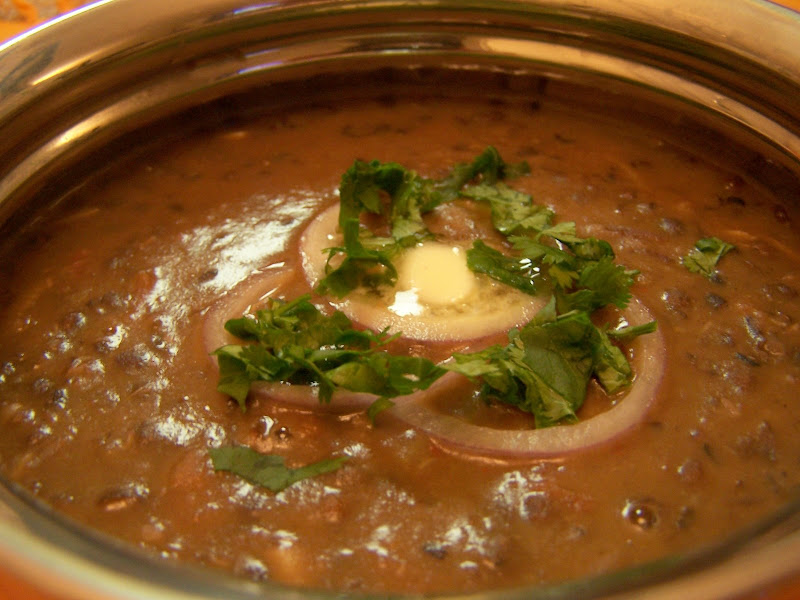
Daal Makhani

Updated on 11/25 for 'Think Spice - Think Ginger'

Daal makhani, better known as Kaali daal (black lentils, literally) to me has always been a favorite. It features on the menus of almost all North Indian restaurants, I think it's a place well deserved :)

This is a very simple and easy recipe for daal makhani. Does not require too many ingredients and is one of those things where you can taste every single ingredient :) I normally don't use any butter/creme to make it. I believe correctly cooking the daals is the key to its texture.

Ingredients(Serves 4):
1. 1 Cup Urad daal (whole black gram, not the split one)
2. 1/4th Cup Rajma (red kidney beans)
3. 1/4th Cup Chana daal (split bengal gram)
4. About 1 Tbsp ginger juliennes
5. 2 tomatoes chopped
7. 2-3 cloves of garlic chopped fine
6. 2 Tbsp ghee
7. 2 tsp cumin seeds
8. Red chilli powder and salt to taste
9. A few dry red chillies
10. A big pinch of asafoetida

Method:
1. Wash urad daal, chana daal and rajma well, mix them and soak overnight(about 8 hrs) in lots of water.
2. Add salt to taste and pressure cook the soaked daals. I put the cooker on high flame and after first whistle lower the flame to medium-low. Let it cook for about 5-6 more whistles. There should be enough water or the daal will burn due to the long cooking time.
3. Once the cooker cools down, mix the daals well with a ladle, urad daal should be very soft , chana daal should almost dissolve, rajma will be as it is. This is how you get the creamy consistency, long cooking time is the key. If you can see the water separated from the urad daal, you probably need to cook for one more whistle.
4. Then add ginger juliennes (more the better, but depends on your love for ginger).
5. Now for tempering/tadka - heat ghee (or butter), add hing (asafoetida), cumin, dry red chillies and chopped garlic.
6. Fry a little and then add tomatoes.
7. Once tomatoes are soft, add some red chilli powder and then add the daal. Let it simmer for a while (10 mins or so on medium heat).


If you want you can add more butter/creme at the end. Its up to you how rich you want to make it. Since my mom makes it very frequently, she doesn't add any
butter/creme. Garnish with creme/butter and fresh cilantro.

Serve with parathas/naan/jeera rice and don't forget to serve some onions soaked in lime/vinegar (and salt) on the side :) Baingan ka bharta goes hand in hand with this daal. It tastes best the next day with fresh, crisp parathas.


Thoughtful Bee of Jugalbandi suggested that I send this as an entry to Sunita's (of Sunita's World) 'Think Spice' event. The theme this month is 'Ginger', a spice I love. A ginger relish made with lemon juice, green chillies and salt used to be a regular feature on our dining table in my parents home (talented Passionate Baker made it for this event :)). Another favorite is adu-limbu nu sharbat or ginger lemonade. Parthiv and I love it during the summer! And of course cannot fail to mention the importance of ginger tea, the comfort of tea combined with therapeutic ginger fills you up with warmth and soothes sore throats. My favorite mix is grated ginger mixed with black cardmom powder, a pinch of black pepper and honey. This used to be my mom's home made remedy for sore throat and cough.

Coming back to daal-makhani, this is one of those recipes where my love for ginger is quite evident. Ginger juliennes are added raw after the daal has been pressure cooked. It brings out the flavor of the ginger and I love all the spoonfuls that have a little gingery crunch in them!


So with thanks to Bee and Sunita, this post is off to Sunita's 'Think Spice - Think Ginger' event.

Thursday, November 1, 2007

In Search of the Perfect Chole

I feel my search will never end. I make chole in at least 5 different ways, I keep experimenting, adding or removing ingredients, tweaking the procedure one way or another to get the taste that you get in the not-home-made chole. But the search continues. If you have ever tasted 'Havmor' (in Ahmedabad)'s chana-poori, you will know what kind of chole I am talking about. Chole in a dark thick gravy with some mysterious spices, each little chick-pea bursting with flavor to its seams. I know one thing - they use a barrel of fat in them! And I also know that I turn out to be a chicken when it comes to using a lot of oil in my cooking. Not that I don't love deep fried food - kachoris, pooris, my mom-in-law's deep fried farsaans like chakri, sev, farsi poori, peas kachoris, my mom's shakkarpaare, bread pakodas, bread rolls, samosas... bring it on! I'll never say no! :D

So, here we were, eating home-made chole, thinking about a plate of Havmor's, living in perpetual want for the perfect chole... and then we went to a pot-luck party where this lovely girl A (who I met for the first time) brought in some killer chole. It looked like the search had ended :) She sweetly sent me the recipe next day and I didn't waste a day in trying it out. The result - pretty good chole, but still in the same cadre as my other recipes. I just couldn't get mine to taste like hers! Most likely reason - my tendency for avoiding oil!! I then started tweaking her recipe and now we have moved a notch up. Our friends love those and so do we, but the search continues....

I just realized the above paragraph is good for nothing as this post is not about that recipe :D One week-night, it was pretty late by the time I got to the kitchen to cook. Saw these two chickpea cans, opened the freezer to find some frozen parathas. All set for a tasty meal! :)

My colleague Mr. K who is also an Indian (and from Delhi) knows what I mean when I say I need to get my chole right. He is a foodie like me :) He and his wife try several ways to make chole and he always brings me some to taste! A few days back he brought me a packet of 'Shaan Punjabi chole masala'. He said it’s a Pakistani brand and may be worth a shot for a different flavor. The ingredients for this brand of masala are quite different and include Baking soda and garlic. I wasn't sure if I wanted to try out the brand new masala when we were so hungry and this was the only thing I was cooking. So I decided to mix it up with other masalas. Armed with Shaan Chole masala, MDH chole masala and my home made mix of spices, and two chick pea cans I set out to make chole.

Here's the recipe-
Ingredients:
1. 2 cans chickpeas, wash and drain. Or 3 (cooked) cups kabuli chana/chole/chickpeas soaked for 6 hours and pressure cooked with salt to taste.
2. 1 Medium onion (grated or minced)
3. 1 tomato sliced lengthwise
4. 2 tsp chopped green chillies
5. 1 tbsp ginger (grated/ground into a paste)
6. 2 cloves garlic ((grated/ground into a paste)
7. 1 bay leaf
8. 1 tsp cumin (jeera) seeds
9. 0.5 Tbsp Shaan chole masala
10. 1 Tbsp MDH Chole masala
11. 0.5 Tbsp mix of roasted and ground cumin, pomegranate seeds and coriander seeds (1 part of coriander, 1 of cumin and 1/2 of pomegranate seeds - I made this masala for one of my experiments and just happened to have some left over).
12. 1 tsp red chilli powder
13. Salt to taste
14. 1 Tbsp cooking oil

Method:
Heat oil, add bay leaf, cumin, let them get fragrant and a little brown and then add green chillies-ginger-garlic. Sauté and enjoy the aroma :) Now add grated onions. Sauté for about 10 minutes on medium-low heat. If the onions stick to the pan, sprinkle few drops of water once in a while. Let the onions turn golden brown. Once you feel onions are cooked (make sure they are, half cooked onions can mess things up totally) add everything from #9 to #13. Be careful with the salt, canned chickpeas already have salt. Sauté for a minute. Turn the flame to high and add the chickpeas. Mix well to make sure the chole are coated with the masala. Now add a cup of water, bring to a boil. Add half of the sliced tomatoes, lower the heat, cover and let the chole simmer. When chole get to the desired consistency, add a few thinly sliced onions, rest of the tomatoes on top, turn off the flame and cover.

When ready to serve, mix the chole with the onions and tomatoes on top. Onions and tomatoes would have slightly cooked with the steam. Onions lend a nice aroma when you do this. Add more water if the gravy has dried out. Bring to a boil again, garnish with onions, chopped green chillies and fresh cilantro and serve with pooris/bhaturas/parathas.

100_7284


I kept tasting the chole and added masalas as I thought necessary. You can use any one of the three masalas I used or even garam masala. I think the mix of roasted and ground coriander, cumin and pomegranate seeds is the most important ingredients.

I made a quick salad to go with the chole. I had bought this bunch of different colored carrots from Whole Foods. I tasted them and was disappointed, they had no flavor, just the crunch! I assumed the dark purple carrot would be the same as 'Kaali gajar' that we used to get in India sometimes. Mom would make a Kaanji out of Kaali gajar. Its a tangy drink made with mustard, red chilli powder and these carrots. Long slices of carrots are mixed with mustard, red chilli powder, salt and lots of water. This concoction is then allowed to sit in the sun for a day or two. The result is beautiful maroon colored water with a solid tangy flavor... yummm, gotta make that someday! So back to the purple carrots - When I cut them I found only the skin was purple, I felt cheated :(( Ha ha! So after lamenting for a while, I decided to make a quick salad.

Sliced 2-3 carrots in long thin slices, did the same with 1/4th cucumber and *very* little red onions. Mixed it all with salt and lime juice to taste. Warmed 1/2 tsp oil, added 1 tsp raai ki daal (split mustard seeds) to it. Added this tempering to the salad and mixed it well. I would have loved to add slit green chillies as well, but I thought the salad might get too hot for Parthiv :)

This crunchy salad made a perfect accompaniment to the hot chole and parathas.
100_7289

If you read this, I would love to know how you make chole. So do leave me a comment! I will post the other recipe I talked about, soon :D

100_7285

Saturday, October 13, 2007

The Daal Baati Party!

Daal-baati is a staple food item in Rajasthani cuisine. You can also find it featuring in various restaurants and homes in the 'Malwa' region of Madhya Pradesh.

Baatis are small balls of wonder soaked in enormous amount of ghee (clarified butter). If you don't like ghee, baati is not for you! Baati is largely made of wheat flour with addition of another flour in a smaller amount. I have seen them being made with makai (maize) and besan (chickpea) flour. Baatis are normally eaten with daal, where daal preparations vary in every household. Some people make it with panchkuti daal (a mix of 5 lentils), some with a mix of split urad (split black gram) and chana daal (split Bengal gram), some with a mix of tuar (split pigeon pea) and chana daal and many times, with just tuar daal. Similarly, the seasoning varies from a plain tadka (tempering) of ghee, heeng (asafoetida), jeera (cumin) and red chilli powder to a more complex one of the former plus onions, green chillies, tomatoes, garlic, ginger etc.

Accompanying daal baati is normally a dry side. Again numerous possibilities here. But in the various places I have eaten daal-baati, the vegetables used are either potatoes or eggplants or a combination of both. Most common in the marwari households in Indore is sookhe aaloo (potato chunks seasoned with dry spices). Then comes baingan ka bharta (made with fire roasted eggplants). another common side is aloo-baingan ki sabzi (potatoes and eggplants cooked with tomatoes and other spices). A new side that I tried very recently is aloo ka bharta (Indian mashed potatoes if I may).

And then there has to be a platter of pickles and chutneys. Most common being mango or green chilli pickles. Chutneys are normally green chutneys made with cilantro and raw mangoes or lemon juice. The other variety is the fiery garlic and red chillies chutney.

The right way to eat daal baati is using your hands. You are supposed to mash the baati, pour daal over it, add a stream of warm ghee, mix it all and eat with some chutney/pickle and the side sabzi in every morsel.

Now comes my experiences with daal-baati :) We never made it at home! It would be a popular picnic item when cooking was done at the picnic spot. Either a cook who accompanied us or a handful of ladies (and some gentlemen) who were baati experts would be busy preparing the lunch treat. I have clear memories of one such picnic on a field in a small village close to Bhopal. I was a kid at that time and wouldn't have cared less what was for lunch, leave alone how they were making it! So I don't know how they did it without any conveniences of a cozy kitchen!

The next time I had baati after many years was at my dearest friend N's house. Her mom made amazing daal baati, which was always served with oodles of ghee and tons of love. And all the while I was in Indore, she would call me every time she made it :) Those were the days!

And then someone told my dad about a restaurant located in the Cloth Market in Indore. It was called Prithvilok. Now let me tell you what Cloth Market looked like. Cloth market (or Kapda Bazaar) was located in the heart of Indore, a city that was once known for its cloth mills. So it is not hard to imagine the huge trading community in Cloth Market, especially whole-sale. Cloth Market is *always* full of people. To accommodate the cloth merchants who come from all over the country to buy and sell cloth, there were a number of dharamshalas/lodges/hotels in close vicinity. One such lodge was Prithvilok and no marks for guessing that they served food too. The first time we went there was on Sunday afternoon (Cloth Market shops used to be closed on Sunday). We met with a plain facade of a lodge and a long flight of stairs. As we walked up the stairs we saw dormitory like rooms with a good number of beds and people sitting there chatting or lying down. As we went up to the next floor we saw a little lobby leading to the restaurant. And there were rooms at the other end of the lobby. Probably enough to drive people away! But the fact that we were brought there by my father's colleague Mr. A and his insistence on the good quality of the food kept us going. Once we entered the restaurant we were in for a surprise! The restaurant looked nice and new and clean and actually tastefully decorated. Mr. A informed us that it has been renovated over the years. Good :) Now coming to the food, the treat would start with a glass of aam ka panna ( a sweet and tangy raw mango drink) or chach (salted buttermilk) and then followed up with a huge metal thali that a stream of servers would fill even before you could say Thali! There was daal, kadhi, 3-4 vegetables, papads, chutneys, pickles, salads... the usual Indian thali fare. But the fun started when they started bringing in these heavy weight baatis saturated with ghee. These people could continue feeding you forever and ever if you didn't say no! We would always come back with Prithvilok full enough to be sick! :) But it was one amazing place! I don't know if I will even get a chance to visit again. I could still go on about it and this post is already getting way out of limits and I still haven't talked about our own daal-baati party!

So with all those baati experiences it’s not hard to crave for this delicious treat. The first time I had baati in the US was when N visited me in Texas and made her mom proud by making baati for me :) And she did make her mom proud, practically mummy ka naam roshan kiya :) The baatis were so so good, thank you sweetie-pie :)

And then another time was when our marwari friend B treated us to this most amazing daal baati ever! Her recipe was so different, the baatis had a stuffing and the daal was made with split urad. We did not need any sides or any chutneys to go with it! It was just so good!

Several times we have talked about making daal-baati with our friend V (who also happens to be my ex class-mate from Indore). So one Sunday morning (after several failed plans to meet up and make daal-baati), V called his mom in India to get baati recipe. An hour or so later he arrived, armed with the recipe, 2 big eggplants for baingan ka bharta and a jar of ghee :) We set out to make, baatis, daal, baingan ka and aloo ka bharta.

THE BAATIS
Ingredients (for about 15 baatis)-
1. 3 cups whole wheat flour.
2. 1.5 cup chickpea flour (besan).
3. 8 tbsp or so of clarified butter (ghee).
4. Salt to taste.
5. 1.5 tsp baking soda.
6. water to knead.

Method -
Sieve everything except ghee together. Add ghee to the flour gradually, rubbing with your hand. Once all the ghee is mixed, gradually add water and knead as you would do for rotis. The dough has to be firmer than that of roti, more like parathas I would say. The ghee measurement I have given here is approximate. The point is to have enough ghee (yes you have to be a braveheart!) to make a smooth dough. Set the dough aside for 15-30 minutes and then form small golf sized balls with it. Sweet R did this for us, every baati was exactly the same size! :) This being our first attempt at baati, we did not dare try bigger baatis. We were worried they might stay uncooked at the core.

Now preheat your oven to 300 deg F. Grease a baking sheet and place the baatis over it. Bake for about 10-15 minutes (again approximate) I didn't look for the time as I was busy doing other things meanwhile. Sorry! When they start looking cooked, turn them over and bake for another 10-15 minutes. Keep checking back (since I was stupid enough to not note the baking time!) :D
Our baatis cracked on the top! I don't know why, may be my dough did not have enough water! But they tasted great anyways so we didn't mind. When the baatis are done, heat ghee in a sauce pan and dip each baati in it. I remember B had deep fried the baatis in hot ghee before serving.

100_7180

DAAL
Daal this time for us was made with an interesting mix. R had some mixed urad-tuar left over from dinner last night and I had some tuar daal in my freezer. So here's what we did.

1. Heat ghee, add mustard and cumin seeds followed by heeng and curry leaves.
2. Add grated ginger and chopped onions. Sauté till onions are soft.
3. Add chopped tomatoes and slit green chillies and cook till tomatoes are soft and blend with the onions.
4. Now add red chilli powder and turmeric.
5. Add R's (already very tasty) and my thawed tuar daal. Add salt if needed and simmer for 10 minutes.
6. Add fresh cilantro when done.

You can use any combination of daals with this tadka. Most common combos are chana and tuar and chana-urad-tuar.

100_7165

BAINGAN KA BHARTA
Ingredients (serves 4):
1. 2 large eggplants (the roasting variety)
2. 1 cup chopped onions.
3. 1 cup chopped tomatoes.
4. 2 chopped green chillies.
5. Oil to cook
6. salt and red chilli powder to taste.

Method:
1. Roast the eggplants. You can do this in your oven or on the stove top. I placed a perforated grill plate on the stove (at medium heat) and placed the eggplants over it. As the skin begins to char, keep rotating the eggplants to cook uniformly. This will take about 20 minutes (more in the oven, but oven is less messy and roasting is more uniform. Make sure all doors and windows are open or your home will smell like a roasted eggplant for 3 days! Lighting a candle helps :)
2. When eggplants are thoroughly cooked (insert a knife and make sure it goes all the way in easily), immerse them in cold water.
3. Ad they cool down, remove the skin with your hands and give a quick wash to the eggplant insides. mash into a pulp.
4. Heat oil (about 1.5 tbsp), add onions and sauté. After 2 minutes or so add tomatoes and green chillies. Again sauté for 2 minutes.
5. Now add the eggplant pulp, red chilli powder and salt. Mix well and suate for 5 minutes.
6. Let the bharta cook till oil separates (my oil never separated! although I did put in a lot of it!)
7. Add chopped spring onions/cilantro or both for garnishing.

You can always add garlic or other spices of your choice. I just did what my mom does :) and I just love her bharta . You can also add green peas with the eggplant pulp. I didn't do it this time, I had a feeling peas will break the smooth texture of the bharta needed to go with the baatis.

100_7168

ALOO KA BHARTA
(serves 4)
1. Boil and peel 4 medium potatoes.
2. Add salt to taste and mash.
3. Heat 1 tbsp oil, add mustard seeds and 2 finely chopped green chillies.
5. As mustard begins to splutter, add heeng and curry leaves.
6. Turn off the flame, wait for a minute and then add 1/4 tsp of turmeric powder.
7. Add this tempering to the mashed potatoes and mix well. I heated the potatoes while mixing the tempering.
8. Turn off the heat and add lemon juice to taste.
9. Garnish with cilantro and desiccated coconut (R's idea :))

100_7179

LAHSUN KI CHUTNEY (Garlic chutney)
1. We used maharashtrian peanut chutney as base for this chutney.
2. Heat oil, add 4-5 roughly chopped cloves of garlic and let them turn golden. Add 2 dry red whole chillies. Mix in the peanut chutney.
3. let cool and grind to a fine paste with salt and a little lime juice.

If you don't have peanut chutney handy, use roasted peanuts, cumin seeds and increase the amount of red chillies.

I think that is it!

We then spread out a table cloth on the floor. We had to eat our baatis right! Where sitting on the floor, cross-legged and eating with our hands is the RIGHT way :)

100_7183

This is what my plate looked like (Clockwise - red chilli pickle, baingan bharta, aloo ka bharta, chopped onions, lahsun ki chutney and crushed baati topped with daal). We refrained from adding extra ghee but that would be the right RIGHT way to eat your baatis :)
100_7186

Friday, October 5, 2007

Methi wala kaddu and tari wali barbati

I am pleased with the title of this post, both 'kaddu' and 'barbati' are words that I don't get to hear very often nowadays :) Just another wave of nostalgia I guess! :)

I have been eyeing pretty looking Banana Squash at the grocery store for quite a while now but never tried cooking it. The other day I suddenly remembered the 'methi wala kaddu' (Indian Pumpkin seasoned with fenugreek seeds. Where Indian pumpkin is something close to butternut squash) that my mom used to make. And it felt like I had found some use for the banana squash :) Here's her recipe -

Ingredients: I am not giving exact measurements as this preparation doesn't need any!
1. Banana squash peeled and cubed. It was quite easy to peel using a regular peeler.
2. A little oil to cook.
3. Chopped green chillies, onions and garlic
4. Lemon juice
5. 1/2 tsp fenugreek seeds, 1/2 tsp mustard seeds, 1 tsp cumin seeds. (In other words, use less fenugreek and mustard, and more cumin :))
6. Red chilli powder, turmeric and salt to taste
7. Fresh cilantro -chopped. I didn't have it, so I used spring onions.

Method:
1. Heat oil, add all the seeds and let them splutter.
2. Add garlic, followed by green chillies and onions. Saute a little bit. Don't let them brown.
3. Add chilli powder and turmeric, saute.
4. Mix banana squash cubes, sprinkle salt to taste and mix well.
5. Add a tbsp of water, mix, cover and cook for 5-7 minutes on medium heat.
6. When the squash is cooked, turn off the heat and stir in cilantro (I used spring onions) and lemon juice to taste.
7. Cover and let the flavors sink in.
8. Serve with fulkas/paratha and a wedge of lime.

Actually the spring onions went quite well with the other flavors. I might add it the next time, even if I have fresh cilantro. Mind you, the dish has a slightly bitter taste because of the fenugreek seeds, but I think that is what makes this preparation special! :)

I served it as a side to tari wale barbati/lobia/rongi/rawan/chowli/black-eyed peas :)

100_7210

This is how I made the barbati.
Ingredients (serves 2)
1. 1/2 cup black-eyed peas
2. 1/2 onion grated/chopped fine
3. 2 tomatoes pureed
4. 2 tsp ginger/garlic/green chilli paste
5. Masala - 1 tsp red chilli powder, 1/2 tsp turmeric powder, 1 tsp coriander powder
6. Oil about 1/2 tbsp

Method:

1. Soak black-eyed peas for about 2 hours in cold water. Pressure cook for 3 whistles with a little salt and enough water to immerse the beans. I prefer not to cook the beans too much initially as they should retain their shape.

2. Heat oil, add onions, ginger-garlic-chilli paste and tomatoes. (I put them all in the chopper together and chopped fine. My mom grinds them all - I am not fortunate enough to have an Indian blender like she has :) Turns out to be pretty quick and doesn't seem to matter though!)

3. After about 5-7 minutes of sauteeing as oil begins to separate, add all the masalas and a little salt. At this step I also added some chopped green bell-peppers, a lovely tip from dear Musical of Musical's Kitchen. Saute for a minute.

4. Add cooked black-eyed peas with the water it was pressure cooked in. Simmer for about 10 more minutes till you get desired consistency of the gravy.

5. Add fresh coriander.

Alternatively, you can also avoid pre-cooking the black-eyed peas. Just prepare the masala as in step 2 and 3, in step 4 add soaked black-eyed peas and then pressure cook for 4 whistles. I didn't do it this way this time around as I didn't want my bell peppers to over cook :)

For the extra dash of flavor, you can sprinkle some garam masala or chana masala at the end.

This meal was very close to a typical sunday meal at my parent's home. The only thing missing was chaach or namkeen lassi as punjus call it :) We would *always* have salad at home, so I made sure I at least had some chopped cucumber with this meal :)


100_7208

Monday, September 10, 2007

Idli Sambhar and Uttapams

I LOVE South Indian food. Only rajma-chawal (kidney beans and rice) come close to my love for masala dosa. I love sambhar, fluffy idlis, crispy vadas, slurpy rasams, the wide variety of rice preparations - lime rice, curd rice, tamarind rice, bisi-bele bhaat, that great variety of chutneys and pickles - just love it all!!

We normally eat south Indian food every two weeks at least. I soak a big batch (too big for the two of us anyways) of rice and daal, make two batches of idlis right away and refrigerate the rest of the batter. Some idlis go in the freezer while some make for lunches. And we have dosas and uttapams for dinner.

Ingredients for basic batter - I realize there are various rice-lentil proportions used to make idlis and dosas. The following makes good idlis and pretty good dosas too, so I just stick to it.
1. 2 Cups rice (parboiled works the best, I mistakenly bought it one time - it made the best idlis ever). But considering that parboiled rice is not available in small packs, I make do with basmati.
2. 1 Cup dhuli urad daal (split black gram).
3. 1 tsp methi (fenugreek) seeds.

Wash and soak the daal and rice (with fenugreek seeds) separately for at least 6 hrs.
Drain water and grind separately. Daal is easier to grind, rice is more of a challenge. Mix well (I mix the batter by hand), cover and let ferment for 10-12 hrs. Fermentation depends on the temperature. This time when I made the batter, it was a towering 102 degrees outside. After letting the batter sit overnight, I kept it in the patio for 2 hrs. When I checked it, the batter had risen all the way to the top! My heart danced, we were going to get fluffy idlis!!

My mom-in-law got me this set of moulds and a stand with a steamer which is one of my favorite things in my kitchen :) . I use non-stick spray to grease the idli moulds. Works very well.

So here's what I do from here - I like to make idlis right away without putting the batter in the fridge. Add a little salt to taste and very gently mix the batter (you don't want to lose all that trapped air). The idli batter should not be thin, a watered down batter will yield flat idlis. While you fill the moulds with idli batter, fill a little water in a steamer/large stock pot and let it come to a boil. You need to make sure that the water will not touch the last idli plate (I just realized I need to take some pics of the moulds and the idli stand to make more sense!)Once water comes to a boil, place the stand in the steamer/stock pot and cover. Keep the flame medium-high. Idlis are normally done in 10-12 minutes. Insert a fork and check if they are done, if it comes out clean you are good to go! Let the idlis cool down for a few minutes before removing them from the moulds.

I let the idlis cool and store one batch in the fridge and one in the freezer. They reheat very well if you sprinkle a few drops of water and partially cover them while microwaving. 30 secs works for me.

100_7096

To make dosas/uttapams from the remaining batter - I remove the batter from the fridge and let it warm up to room temperature.

For uttapams (Parthiv is my dosa/uttapam expert btw :)) - Add chopped onions, tomatoes, green chillies, cilantro and salt to the batter(you can also add chopped cabbage and grated carrots). If it's too thick, add water to bring it to a pourable consistency. Heat a non-stick pan, spread a few drops of oil on it. Spread uttapam batter just like you would do for a pancake/cheela/pooda/pudla. Cover with a lid and let it cook for a minute or two. Add a few more drops of oil on the side up and then flip. Let cook without covering. Keep flipping and roasting till the uttapams are golden and crisp.

Serve with hot sambhar, coconut and tomato chutneys! :) I will post sambhar and chutney (recipe here) recipes soon... do check back! :)

100_7094

Thanks to sweet Asha's suggestion, I am also submitting this recipe for RCI Karnataka (hosted by Asha of Foodie's Hope).

rciK

Monday, September 3, 2007

Food for the soul - Khichdi

I have not always loved khichdi. In fact, when I was younger khichdi always made me think of being sick. What my little head didn't know at that time was that khichdi is the epitome of comfort food, something that would bring relief to your sick tummy and your depressed soul :) So, slowly and steadily I learnt to love it. My relationship with khichdi once again turned sour when I moved to a hostel for my bachelors. The lady who ran our mess thought of khichdi as a means to use up her (probably) several days old leftovers, and that didn't go too well with my palette. She thought we'd never know if everything was mashed well enough! I sometimes wish it worked that way :)

Well, I didn't stay in the hostel too long and slowly and steadily we were friends again. After meeting Parthiv I was quite happy to find that we shared our love for khichdi. I was used to eating yellow moong daal khichdi with ghee/dahi/raita and Parthiv loved green moong khichdi with gujarati kadhi. So I moved on to green khichdi, but I would still continue to eat it with dahi and make kadhi for Parthiv. And then the new love affair began, I discovered khichdi and kadhi were meant to go hand in hand and happily embraced the combination.
We were visiting my friend R for her baby shower on Saturday. Since dinner was going to be quite elaborate, her mom made a simple sabudana ki khichdi lunch for us. She asked us if were interested in tasting some masala khichdi she had made the day before. I had a spoonful of it and my love for yellow khichdi flared again :) So, I decided to make it for lunch on sunday. One thing that was different in the gujarati style khichdi was the use of mustard for tempering. So I kind of tried to reproduce the amazing taste. Here's the recipe (serves 2)-

Ingredients:
0.5 cup rice (I used basmati)
0.5 cup yellow moong daal - wash and soak for about 15-20 mins.
2 - 2.5 cups water
1.5 tsp mustard seeds
2 cloves
a pinch of heeng (asafoetida)
1 tsp dhana-jeera (coriander-cumin) powder
1 tsp turmeric
2 tsp red chilli powder
1.5 - 2 tsp or so of garam masala (preferably non-punjabi style. I think 'MDH' garam masala fits the bill for punjabi garam masala. For my gujarati preparations, I prefer using 'Mother's recipe' brand of garam masala)
salt to taste
1 tblsp ghee/oil (preferably ghee)
1 medium tomato -chopped
A handful of chopped cilantro to garnish

Method:
1. Wash and soak moong daal for 15-20 mins.
2. Wash rice.
3. Heat ghee in a pressure cooker. Add mustard seeds and cloves.
4. As they begin to splutter, add heeng and the rest of the dry spices. Tip: measure and mix your spices before-hand.
5. Quickly add chopped tomato. Be very careful in steps 4 and 5. You have to be quick or the spices will burn.
6. Saute for half a minute or so and add daal-rice mixture. Mix well and add 2.5 cups of water. If you want your grains to be separate, add only 2 cups of water.
7. Add salt, mix and pressure cook for 3-4 whistles. 3 whistles for separate grains.
8. Let the pressure cooker cool down. If you feel the khichdi is not cooked yet, add a little more water and cook some more.
9. Add cilantro and mix.

To serve:
We had khichdi topped with a tsp of ghee, with yoghurt, store bought ginger relish/pickle and roasted papads on the side. Parthiv hates pickles so he had his khichdi with just papad.

100_7072

For healthy variations, you can add peas, carrots, green beans etc. I was tempted to add some sprouted moong but did not want to play around with the taste I was trying to recreate. I wanted my khichdi on the spicy note. You can vary the quantity of spice to suit your taste.

100_7069