Showing posts with label Gujarati. Show all posts

Saturday, May 10, 2008

Dressed up Dhokla!

It's high time I get back to my blog :) Initially I was actually occupied with worldly matters, but I don't think I have an excuse now! I've just been out of touch with my little blog world out here! Can't wait to get started again!

I never knew the difference between Gujarati Khaman and Dhokla. To me there were yellow dhoklas and white dhoklas. I did discover in time that Khaman or my so called yellow dhokla is made with chickpea flour or ground bengal gram (chana daal). Where as the 'white' variety could be made with rice or sooji/rava/semolina and is called Dhokla :). Both of us prefer dhokla over Khaman for some undefined reason! Both are equally delicious! I have always used Gits instant mixes to make dhoklas but this time I tried making them with sooji. I got the basic recipe from Trupti's 'The Spice Who Loved Me'. A beautiful blog with a ton of great recipes. A great tutorial blog for someone like me who is still a novice at Gujarati cooking! This dhokla recipe is perfect, its as simple as it gets and the result is light, fluffy, absolutely delicious dhoklas. Thanks Trupti!

Dhokla
Ingredients:
Sooji/Semolina - 1 Cup
Besan/Chickpea flour - 1 Tbsp
Yogurt (preferably sour) - enough to bring everything together
Asafoetida (heeng) - a fat pinch
Turmeric (haldi) - a tiny pinch
Salt and Sugar to taste - don't skip the sugar, a tiny bit rounds off the flavors very well :)
Baking Powder - a pinch
Lemon juice - 2 tsp
Eno/Fruit Salt - 1 tsp

Method:
Mix everything except lemon juice and eno together to idli batter like consistency. Let stand for 10 mins. In the meanwhile heat water in a steamer. Grease plates for steaming the dhokla. I used two plates, you can use one if it is large enough to leave room for the dhoklas to rise. Just before steaming, mix lemon juice and eno to the batter and blend lightly using your hand. The batter will turn a little frothy. Pour in the steaming plates. I sprinkled red chile powder over the batter in one plate and freshly ground pepper on the other. Steam covered for 15 mins. Insert a fork and if it comes out clean, dhokla is ready. Remove plates from steamer and let cool for 5 mins.

Chutney -
Cilantro leaves - 1 Cup
Fresh mint leaves - a handful
Green chiles - 2
A tiny piece of ginger
Peanuts - 1 tbsp
Salt and lime juice to taste.

Grind everything together to a smooth chutney.

Assembling -
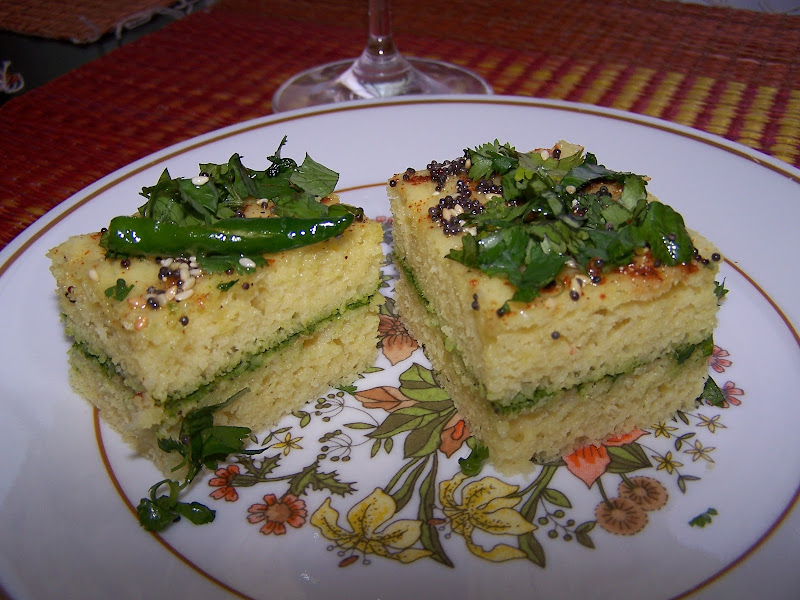
Remove one layer of dhokla on a plate and apply green chutney liberally. Cover with the other layer of dhokla.

Tempering -
Heat 2 tsp oil, as it warms add a tsp of mustard seeds (rai) and a slit green chile. When mustard begins to crackle, add a tsp of sesame seeds. Pour this mix over the dhokla and sprinkle chopped cilantro.
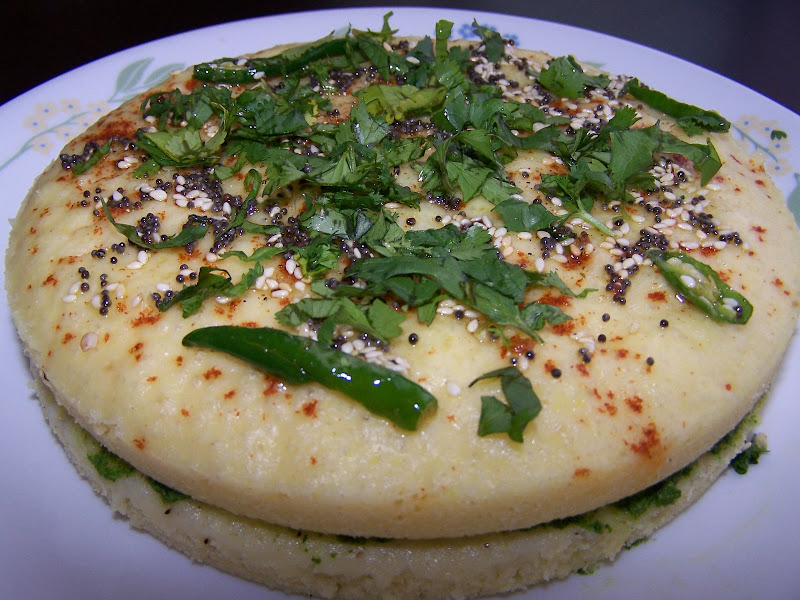


Cut the dhokla in square pieces and serve warm! Cold coffee made a great accompaniment to these dhoklas for a summer weekend breakfast! If you don't have time to make chutney, ketchup works very well too. You can spice up the ketchup with a dash of hot sauce for that extra kick :) These dhoklas are great even if you skip the whole layering business and just temper them with mustard and sesame seeds. We usually have dhoklas without any tempering - with just red chile or black pepper sprinkled on top. In that case, adding a little ginger-green chile paste to the batter (like Trupti did) would be a great idea!
Monday, September 3, 2007

Food for the soul - Khichdi

I have not always loved khichdi. In fact, when I was younger khichdi always made me think of being sick. What my little head didn't know at that time was that khichdi is the epitome of comfort food, something that would bring relief to your sick tummy and your depressed soul :) So, slowly and steadily I learnt to love it. My relationship with khichdi once again turned sour when I moved to a hostel for my bachelors. The lady who ran our mess thought of khichdi as a means to use up her (probably) several days old leftovers, and that didn't go too well with my palette. She thought we'd never know if everything was mashed well enough! I sometimes wish it worked that way :)

Well, I didn't stay in the hostel too long and slowly and steadily we were friends again. After meeting Parthiv I was quite happy to find that we shared our love for khichdi. I was used to eating yellow moong daal khichdi with ghee/dahi/raita and Parthiv loved green moong khichdi with gujarati kadhi. So I moved on to green khichdi, but I would still continue to eat it with dahi and make kadhi for Parthiv. And then the new love affair began, I discovered khichdi and kadhi were meant to go hand in hand and happily embraced the combination.
We were visiting my friend R for her baby shower on Saturday. Since dinner was going to be quite elaborate, her mom made a simple sabudana ki khichdi lunch for us. She asked us if were interested in tasting some masala khichdi she had made the day before. I had a spoonful of it and my love for yellow khichdi flared again :) So, I decided to make it for lunch on sunday. One thing that was different in the gujarati style khichdi was the use of mustard for tempering. So I kind of tried to reproduce the amazing taste. Here's the recipe (serves 2)-

Ingredients:
0.5 cup rice (I used basmati)
0.5 cup yellow moong daal - wash and soak for about 15-20 mins.
2 - 2.5 cups water
1.5 tsp mustard seeds
2 cloves
a pinch of heeng (asafoetida)
1 tsp dhana-jeera (coriander-cumin) powder
1 tsp turmeric
2 tsp red chilli powder
1.5 - 2 tsp or so of garam masala (preferably non-punjabi style. I think 'MDH' garam masala fits the bill for punjabi garam masala. For my gujarati preparations, I prefer using 'Mother's recipe' brand of garam masala)
salt to taste
1 tblsp ghee/oil (preferably ghee)
1 medium tomato -chopped
A handful of chopped cilantro to garnish

Method:
1. Wash and soak moong daal for 15-20 mins.
2. Wash rice.
3. Heat ghee in a pressure cooker. Add mustard seeds and cloves.
4. As they begin to splutter, add heeng and the rest of the dry spices. Tip: measure and mix your spices before-hand.
5. Quickly add chopped tomato. Be very careful in steps 4 and 5. You have to be quick or the spices will burn.
6. Saute for half a minute or so and add daal-rice mixture. Mix well and add 2.5 cups of water. If you want your grains to be separate, add only 2 cups of water.
7. Add salt, mix and pressure cook for 3-4 whistles. 3 whistles for separate grains.
8. Let the pressure cooker cool down. If you feel the khichdi is not cooked yet, add a little more water and cook some more.
9. Add cilantro and mix.

To serve:
We had khichdi topped with a tsp of ghee, with yoghurt, store bought ginger relish/pickle and roasted papads on the side. Parthiv hates pickles so he had his khichdi with just papad.

100_7072

For healthy variations, you can add peas, carrots, green beans etc. I was tempted to add some sprouted moong but did not want to play around with the taste I was trying to recreate. I wanted my khichdi on the spicy note. You can vary the quantity of spice to suit your taste.

100_7069